
Skip to content

Solar Panel Cleaning

A complete look at how solar panel cleaning works, what it costs, and when professional service makes sense.

Overview

Solar panel cleaning removes dust, pollen, bird droppings, leaves, mineral residue, and other surface contamination that can interfere with sunlight reaching photovoltaic cells. Professional cleaning restores a clear module surface without using abrasive tools or chemicals that can damage solar equipment.

SolarReadyHub helps homeowners and businesses determine when solar panels need cleaning, which cleaning methods suit the system, and when professional service makes more sense than DIY work. Panel count, roof access, array size, contamination level, water quality, weather, and surrounding environmental conditions all affect the cleaning approach.

Cleaning requirements also vary by property. A residential rooftop near trees can face pollen and bird activity, while a commercial array near construction, agriculture, or high-traffic areas can collect heavier airborne debris.

Need solar panel cleaning? Explore professional cleaning options for residential and commercial systems below.

Process

How Does Solar Panel Cleaning Work?

Solar panel cleaning removes material from the module surface while protecting glass, coatings, seals, wiring, mounting equipment, and nearby roof components. The cleaning process should address the type of contamination rather than apply one aggressive method to every array.

A solar panel cleaning service typically starts with a visual inspection. The technician checks the modules for accumulated dirt, bird droppings, leaves, staining, visible damage, and access conditions before selecting the cleaning method.

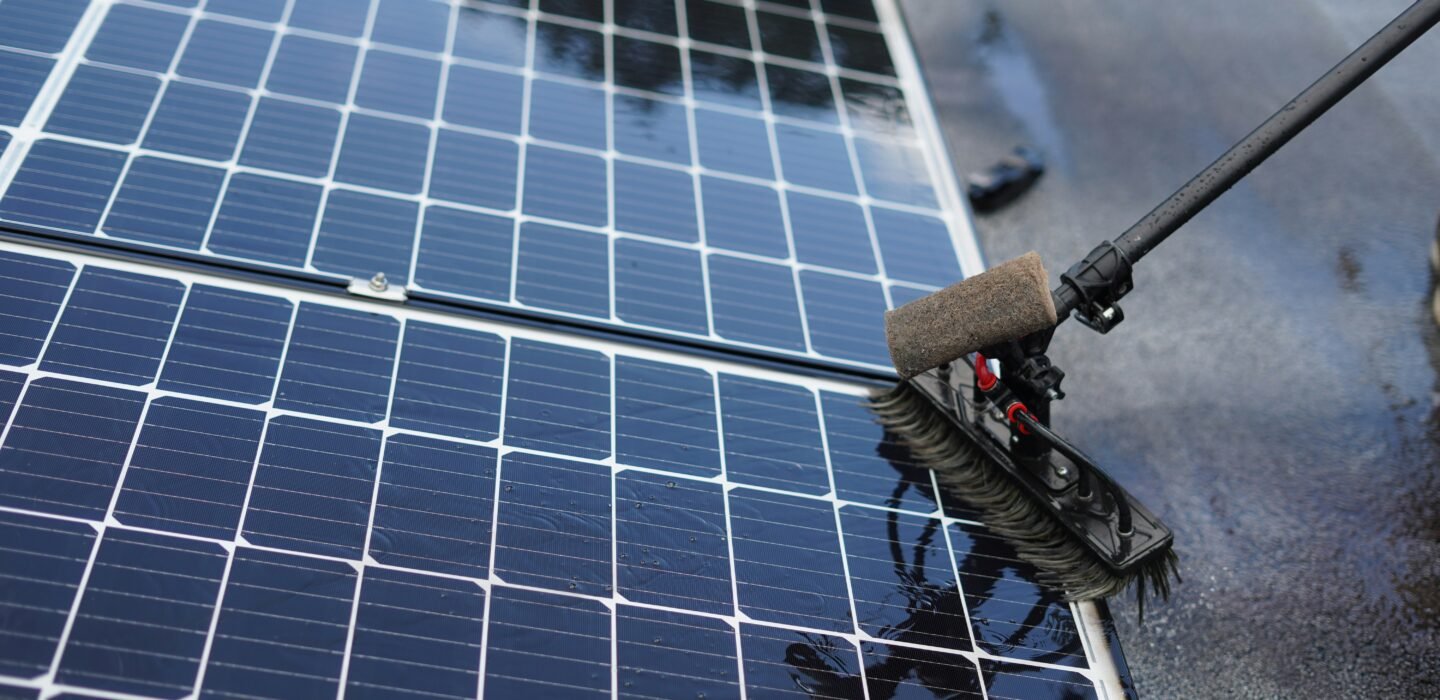
Loose debris can require gentle removal before washing begins. Water and solar-safe cleaning tools then loosen remaining contamination. Soft brushes or non-abrasive equipment remove material without scratching the module glass.

De-ionized or purified water can reduce mineral residue where local water contains dissolved minerals. The technician then checks the cleaned surfaces and surrounding array for remaining contamination or visible concerns.

Cleaning Stage What Happens
Visual inspection Technician checks contamination, access, and visible module condition
Debris removal Loose leaves and other material leave the panel surface
Surface washing Water loosens dust, pollen, droppings, and residue
Gentle agitation Solar-safe brushes address attached contamination
Rinse Clean water removes loosened material
Final check Technician checks module surfaces and visible system condition

Cleaning should remove contamination without introducing unnecessary mechanical or chemical stress to the photovoltaic modules.

Why Cleaning

Why Do Solar Panels Need Cleaning?

Solar panels need cleaning when accumulated material blocks sunlight or creates uneven contamination across the module surface. Dirt does not automatically mean a system has a serious performance problem, but persistent buildup can affect the amount of sunlight reaching photovoltaic cells.

Dust represents one common source of soiling. Dry weather, nearby roads, construction, agriculture, and exposed soil can increase airborne particles around an array.

Pollen can create seasonal buildup, particularly around properties with substantial vegetation. Bird droppings create more concentrated contamination and can remain attached after light rain. Leaves and plant debris can collect around modules and racking, especially on lower-pitch roofs.

Hard water introduces another concern. Tap water containing dissolved minerals can leave spots or residue as water evaporates. Repeated mineral deposits can make the module surface more difficult to clean.

SolarReadyHub treats cleaning as a condition-based service. The amount and type of contamination determine whether natural rainfall remains sufficient or professional cleaning becomes appropriate.

Residential

Residential Solar Panel Cleaning

Residential solar panel cleaning addresses contamination on rooftop and ground-mounted systems while accounting for roof access, panel count, landscaping, bird activity, and local environmental conditions.

A homeowner may notice visible dust or bird droppings before monitoring shows an obvious production change. Another system can appear relatively clean from ground level while sections farther up the roof collect pollen, leaves, or residue.

Roof pitch and height matter because cleaning becomes a safety issue as soon as accessing the array requires working at elevation. Wet roof surfaces and water around electrical equipment create additional reasons to avoid improvised cleaning methods.

Residential service should also distinguish cleaning from repair. Washing cannot correct cracked glass, damaged cells, loose wiring, inverter faults, or other electrical problems. A technician who notices visible damage during cleaning can recommend an appropriate inspection instead of treating every performance issue as dirt.

Residential Solar Panel Cleaning

Commercial

Commercial Solar Panel Cleaning

Commercial solar panel cleaning addresses larger arrays where panel quantity, roof configuration, access, operating schedules, and contamination sources can change the cleaning strategy.

Commercial systems can contain substantially more modules than residential arrays. Large flat or low-slope roofs can also create different drainage and soiling patterns. Dust, pollen, bird activity, nearby construction, industrial activity, and environmental exposure can affect sections of the array differently.

Cleaning plans should therefore consider the complete system rather than simply establish one schedule based on calendar dates.

Access planning becomes particularly important for commercial buildings. Technicians may need to work around roof equipment, restricted areas, drainage systems, skylights, and other building features while protecting both the solar array and roof surface.

For businesses, cleaning also connects directly with system monitoring. Production data can help identify whether performance changes align with contamination or whether maintenance and electrical diagnosis deserve attention.

Commercial Solar Panel Cleaning

Frequency

How Often Should Solar Panels Be Cleaned?

Solar panels do not require the same cleaning frequency at every property. Dust levels, rainfall, pollen, bird activity, nearby trees, roof angle, local air quality, and surrounding land use influence how quickly contamination accumulates.

A fixed monthly or annual rule can therefore create unnecessary cleaning at one property and insufficient cleaning at another.

How Often to Clean Solar Panels
Site Condition Potential Cleaning Consideration
Frequent dust Inspect for visible surface buildup
Heavy pollen season Check modules after peak pollen periods
High bird activity Address concentrated droppings when buildup develops
Nearby trees Watch for leaves, pollen, and organic debris
Limited rainfall Natural rinsing may occur less frequently
Construction nearby Monitor dust accumulation during active work
Hard water exposure Avoid cleaning methods that leave mineral deposits
Low-pitch array Check whether debris remains on module surfaces

Visual inspection and monitoring data provide better guidance than an arbitrary schedule. A property with little contamination may need less frequent cleaning, while an exposed array can require additional attention.

DIY vs Pro

Professional Solar Panel Cleaning vs. DIY Cleaning

Professional and DIY solar panel cleaning differ most in access, safety, equipment, cleaning technique, and the ability to recognize visible system problems.

Ground-accessible panels can present a different cleaning situation from modules installed on a steep second-story roof. The cleaning task may appear simple, but accessing the array can introduce fall hazards and increase the chance of damaging roofing materials or solar equipment.

Factor Professional Cleaning DIY Cleaning
Roof access Trained service approach Property owner assumes access risk
Equipment Solar-safe professional tools Depends on available household equipment
Water treatment Purified or appropriate water can be used Tap water may leave mineral residue
Contamination Service can address different soiling types Technique may vary
Visible condition check Technician can note apparent concerns Damage can be harder to recognize
Convenience Service handles complete cleaning Property owner performs the work

DIY cleaning should never involve unsafe roof access or aggressive cleaning equipment. Pressure washers, abrasive brushes, metal tools, and unsuitable chemicals can create unnecessary risk to module surfaces, seals, wiring, or nearby roofing.

How to Clean Solar Panels

Equipment

What Equipment Is Used to Clean Solar Panels?

Professional solar panel cleaning uses equipment designed to remove contamination without scratching module glass or damaging surrounding components. Water-fed poles, soft brushes, non-abrasive tools, and purified water systems can form part of the cleaning setup.

  • Soft Brushes & Extension Tools

    Soft brushes loosen dirt and attached residue while reducing abrasion risk. Extension equipment can allow technicians to reach panels without placing unnecessary weight around the array.

  • Water Quality & Water-Fed Systems

    De-ionized water contains fewer dissolved minerals than untreated tap water and can reduce spotting after evaporation. Water-fed systems can deliver purified water directly to the cleaning head for controlled washing.

  • Robotic Cleaning Systems

    Robotic cleaning systems represent another option for certain large commercial or utility-scale arrays. Automated equipment can address repetitive cleaning across extensive module surfaces, although system design, economics, and site conditions determine suitability.

Cleaning equipment should match the array. A residential roof with 20 modules does not require the same setup as a commercial installation containing hundreds of panels.

Solar Panel Cleaning Equipment

Rain & Weather

Can Rain Clean Solar Panels?

Rain can remove some loose dust and surface material, but rainfall does not guarantee complete solar panel cleaning. Bird droppings, sticky pollen, lichen, mineral residue, and attached contamination can remain after rainfall.

Roof angle also changes how effectively rain moves material away from module surfaces. Water can carry loose debris downward while leaving concentrated residue near panel edges or in areas where material adheres to the glass.

A useful comparison comes from vehicle glass. Rain can remove loose surface dust, but rain does not necessarily remove attached bird droppings or all road residue. Solar module surfaces can experience a similar distinction between loose and attached contamination.

Natural rainfall can therefore reduce cleaning requirements at some properties without eliminating the need for inspection.

The decision should depend on visible condition and system performance rather than assuming every rainfall event fully cleans the array.

Performance

Can Dirty Solar Panels Reduce Energy Production?

Dirty solar panels can produce less electricity when contamination reduces the amount of sunlight reaching photovoltaic cells. The actual effect depends on contamination type, severity, distribution, local sunlight, module configuration, and system conditions.

A thin, relatively uniform layer of dust creates a different condition from concentrated bird droppings covering part of a module. Heavy contamination can also create uneven exposure across the array.

However, lower solar production does not automatically prove that panels need cleaning.

Cloud cover, seasonal sunlight, shading, high temperatures, inverter faults, wiring problems, module degradation, and equipment failures can also change output. Cleaning a physically clean array will not correct an electrical fault.

Monitoring data can help distinguish a gradual or unusual production change, but diagnosis may require inspection when the cause remains unclear. If output remains abnormal after surface condition has been addressed, solar panel maintenance or solar panel repair can investigate the underlying system.

Pricing

How Much Does Solar Panel Cleaning Cost?

Solar panel cleaning cost depends on panel count, array size, roof height, roof pitch, access, contamination level, cleaning method, water requirements, and property type.

A small ground-accessible array requires a different amount of labor from a large rooftop system with difficult access. Heavy bird droppings, persistent residue, or extensive contamination can also increase cleaning time.

Commercial arrays require separate pricing considerations because hundreds of modules, large roof areas, access procedures, and equipment requirements can significantly change the service scope.

Cost Factor Why the Factor Matters
Number of panels More modules increase cleaning area
Roof height Elevated access can increase labor requirements
Roof pitch Steeper roofs can require additional access planning
Contamination Attached material can require more cleaning time
Array size Larger systems require more labor or equipment
Water quality Purified water systems can become part of the service
Accessibility Difficult panel access can increase service complexity
Commercial scale Large arrays require project-specific planning

A professional estimate should evaluate the actual system instead of applying one price to every photovoltaic array.

Solar Panel Cleaning Cost

Timing

When Should Solar Panels Be Cleaned?

Solar panels should be considered for cleaning when visible contamination accumulates, environmental conditions create repeated soiling, or inspection shows that surface buildup requires removal.

Timing can also depend on local conditions. Heavy pollen periods can leave seasonal deposits. Extended dry weather can allow dust to remain on module surfaces. Nearby construction can increase airborne particles. Bird activity can create concentrated contamination regardless of season.

Cleaning time of day deserves consideration because photovoltaic modules can become hot under direct sunlight. Temperature differences between hot glass and cleaning water can create unnecessary thermal stress.

Professional cleaners can schedule work around safe access, module temperature, weather, and site conditions rather than treating cleaning as a purely cosmetic task. SolarReadyHub recommends condition-based decision making because environmental exposure changes from one property to another.

Maintenance

Solar Panel Cleaning and System Maintenance

Cleaning addresses module surfaces, while solar maintenance evaluates the wider photovoltaic system. The two services overlap in system care but solve different problems.

Cleaning removes dust, pollen, droppings, leaves, and other contamination. Maintenance can examine panels, racking, wiring, connectors, inverters, optimizers, monitoring equipment, and visible deterioration.

For example, consider a homeowner who notices a drop in solar production after several dry months. The array also shows visible dust and bird droppings. Cleaning represents a logical first service when contamination clearly covers the modules.

If production remains abnormal after cleaning, the system may require further diagnosis. An inverter fault, wiring issue, damaged module, new shading, or another condition can produce a performance problem that cleaning cannot solve.

This service sequence prevents property owners from assuming that every production decline requires either cleaning or equipment replacement.

Hiring

Should You Hire a Solar Panel Cleaning Company?

Professional solar panel cleaning makes the most sense when the array sits at height, roof access creates fall risk, contamination requires specialized treatment, or the property owner lacks suitable solar-safe cleaning equipment.

The decision should consider more than the appearance of the modules. Roof pitch, building height, panel location, electrical equipment, water access, contamination type, and system size all affect the practical difficulty of the work.

A cleaning company should explain the proposed method before work begins. Property owners should understand how the technician will access the array, which equipment will contact the module surface, what type of water or cleaning solution will be used, and how surrounding roof materials will be protected.

Solar Panel Cleaning Companies

SolarReadyHub gives homeowners and businesses a service-focused path for comparing professional cleaning with DIY methods without assuming professional service is necessary for every lightly soiled array. Explore SolarReadyHub’s complete range of solar panel services to compare options before deciding.

Frequently Asked Questions About Solar Panel Cleaning

Do solar panels need to be cleaned?

Solar panels can require cleaning when dust, pollen, bird droppings, leaves, mineral residue, or other contamination accumulates on module surfaces. Cleaning frequency depends on environmental exposure, rainfall, roof angle, and visible system condition.

How often should solar panels be cleaned?

No single cleaning schedule applies to every solar system. Dust, pollen, bird activity, rainfall, nearby trees, construction, and local environmental conditions determine how quickly panels become dirty.

Can I clean solar panels myself?

Some safely accessible systems can allow basic cleaning, but rooftop access, wet surfaces, electrical equipment, and unsuitable tools can create safety and equipment risks. Professional service becomes more appropriate when safe access or proper cleaning methods remain uncertain.

What should you not use to clean solar panels?

Avoid abrasive brushes, metal scrapers, harsh chemicals, and cleaning methods that can damage module glass, coatings, seals, wiring, or nearby roofing. High-pressure washing can also create unnecessary risk around photovoltaic equipment.

Does rain clean solar panels?

Rain can remove loose dust, but rain may not remove bird droppings, sticky pollen, lichen, mineral residue, or other attached contamination. Visual condition and performance provide better indicators of cleaning needs than rainfall alone.

Does cleaning solar panels improve efficiency?

Cleaning can recover production losses caused by surface contamination because clean module surfaces allow sunlight to reach photovoltaic cells without the same obstruction. Cleaning cannot correct output losses caused by shading, inverter faults, wiring problems, or damaged modules.

How much does solar panel cleaning cost?

Solar panel cleaning prices depend on panel count, array size, roof height, roof pitch, access, contamination, cleaning equipment, and property type. Large commercial arrays and difficult rooftop systems generally require project-specific estimates.

Get a Solar Panel Cleaning Estimate

Solar panel cleaning can remove dust, pollen, bird droppings, leaves, mineral residue, and other contamination while protecting the photovoltaic module surface. The right cleaning approach depends on panel count, roof access, array size, water quality, environmental exposure, and the type of buildup present. SolarReadyHub helps homeowners and businesses evaluate solar cleaning around actual system conditions instead of following one fixed schedule for every array. Professional cleaning can address difficult access and persistent contamination, while monitoring and inspection can determine whether an apparent cleaning problem actually requires maintenance or repair. Need professional solar panel cleaning? Explore residential and commercial solar panel cleaning services below.

Get a Free Quote

Switch to Solar Today

Learn how Solaris delivers sustainable, high-performance solar solutions to reduce energy costs and protect our planet's future.

Our Services